
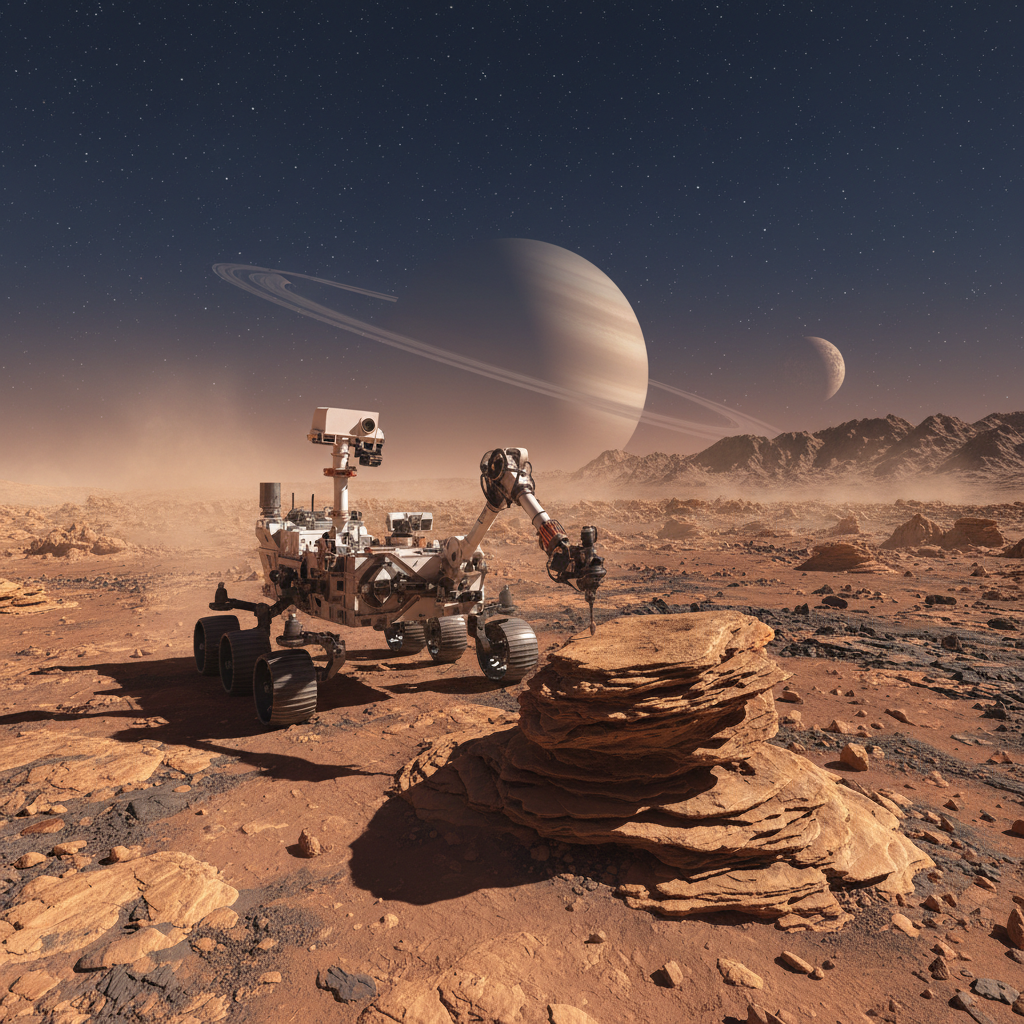
Artificial Intelligence (AI) has become a cornerstone in the quest to explore the vast expanse of space, revolutionizing how we plan missions, navigate the unknown, and understand the cosmos. From the meticulous planning of space missions to the autonomous operations of rovers on distant planets, AI’s role is both expansive and critical.
Mission Planning
In the realm of mission planning, AI algorithms assist in simulating countless scenarios to identify optimal mission paths, equipment configurations, and scientific objectives. This not only enhances efficiency but also significantly reduces the risks associated with space exploration.
Spacecraft Navigation
AI is essential for the real-time navigation of spacecraft, enabling them to adjust their course autonomously to avoid hazards like space debris. This capability is crucial for ensuring the safety and success of missions, especially when direct human intervention is not possible.
Autonomous Rovers and Landers
The Mars rovers, such as Perseverance and Curiosity, are prime examples of AI’s capabilities in autonomous navigation and decision-making in uncharted territories. These rovers analyze their surroundings to safely traverse the Martian landscape, conducting scientific experiments and searching for signs of past life.
Satellite Operations
AI also plays a pivotal role in the management and operation of satellite constellations, optimizing communication paths, data collection, and Earth observation processes. This is evident in projects like SpaceX’s Starlink, where AI assists in coordinating the vast network of satellites.
Data Analysis from Telescopes and Probes
The analysis of data from telescopes and space probes is another area where AI excels, processing vast amounts of information to identify celestial phenomena, from distant galaxies to exoplanets. Space telescopes like the James Webb Space Telescope rely on AI to sift through data, unveiling mysteries of the universe.
Astronaut Support on the ISS and Future Missions
On the International Space Station (ISS), AI enhances astronauts’ capabilities by monitoring health, optimizing work schedules, and even providing psychological support through AI-driven interfaces. This support is anticipated to be crucial for future long-duration missions to the Moon and Mars.
Benefits and Challenges
Utilizing AI in space exploration offers immense benefits, including increased efficiency, safety, and the ability to handle complex tasks autonomously. However, the harsh conditions of space present unique challenges, such as extreme temperatures and radiation, which can affect AI systems’ performance. Developing robust, resilient AI technologies capable of withstanding these conditions is a key focus for researchers.
Potential Future Applications
Looking ahead, AI is expected to play a significant role in deep space missions and the establishment of human settlements on the Moon and Mars. From managing habitat systems autonomously to aiding in scientific research, the potential applications of AI are vast and could be pivotal in humanity’s quest to become a multi-planetary species.
Conclusion
As we continue to push the boundaries of space exploration, AI stands as a powerful ally in our journey. Its ability to process information, make autonomous decisions, and adapt to new challenges could transform our understanding of the universe and our place within it. The future of space exploration, with AI by our side, holds limitless possibilities.
About the Author