
Artificial Intelligence (AI) is revolutionizing how we explore and understand the cosmos. It’s not just about robots and computers; it’s about creating a synergy between human curiosity and machine efficiency that propels us further into the unknown.
At the heart of space science, AI plays a pivotal role in mission planning. It helps scientists and engineers design missions that are more cost-effective and have higher chances of success. Whether it’s charting a course for a spacecraft or deciding the best way to gather data, AI systems offer insights that might not be immediately apparent to human planners.
Data analysis is another area where AI shines. Telescopes and satellites generate vast amounts of data daily. AI algorithms are adept at sifting through this data, identifying significant findings, and even predicting future cosmic events. This capability is crucial for understanding phenomena like black holes, distant galaxies, and the early universe.
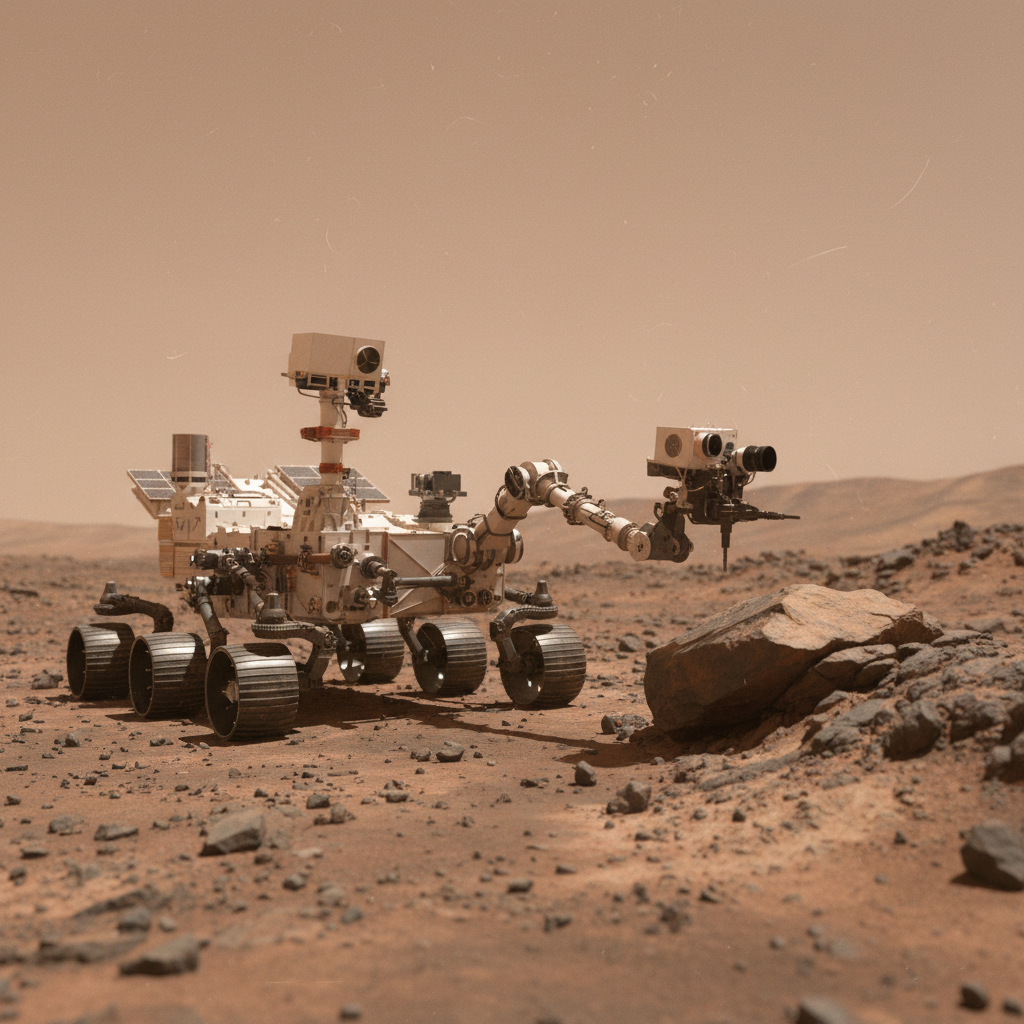
In the realm of Mars exploration, AI has become an indispensable partner. Rovers like NASA’s Perseverance utilize AI for autonomous navigation, making decisions on the move to avoid obstacles and prioritize scientific targets. This self-sufficiency is vital, given the communication delay between Earth and Mars. AI allows these rovers to operate with limited human intervention, choosing paths and targets that promise the most scientific value.
AI’s role extends to pattern detection in large astronomical datasets. It’s instrumental in discovering new exoplanets, identifying stellar formations, and even searching for signs of extraterrestrial life. By recognizing patterns that elude human researchers, AI is uncovering secrets of the universe at an unprecedented pace.
As we look to the future, the integration of AI in space exploration promises even more remarkable achievements. From enabling long-duration missions to distant planets to assisting in the colonization of places like Mars, AI’s potential is boundless. Its ability to process information, make decisions, and learn from outcomes makes it an essential tool for deep space missions.
The collaboration between AI and human ingenuity is opening new frontiers in space science. As this partnership deepens, the possibilities for discovery and exploration are limitless. Indeed, the role of AI in space science is not just transformative; it’s essential for the journey ahead.
About the Author