Diffusion models have swiftly emerged as a powerful class of generative models in artificial intelligence, driving innovation in fields ranging from image synthesis to audio generation. At their core, diffusion models operate on a surprisingly simple yet effective principle: gradually introducing and then reversing noise in data to generate new samples. This guide aims to demystify diffusion models, comparing them with other generative models and highlighting their significance in AI.
What are Diffusion Models?
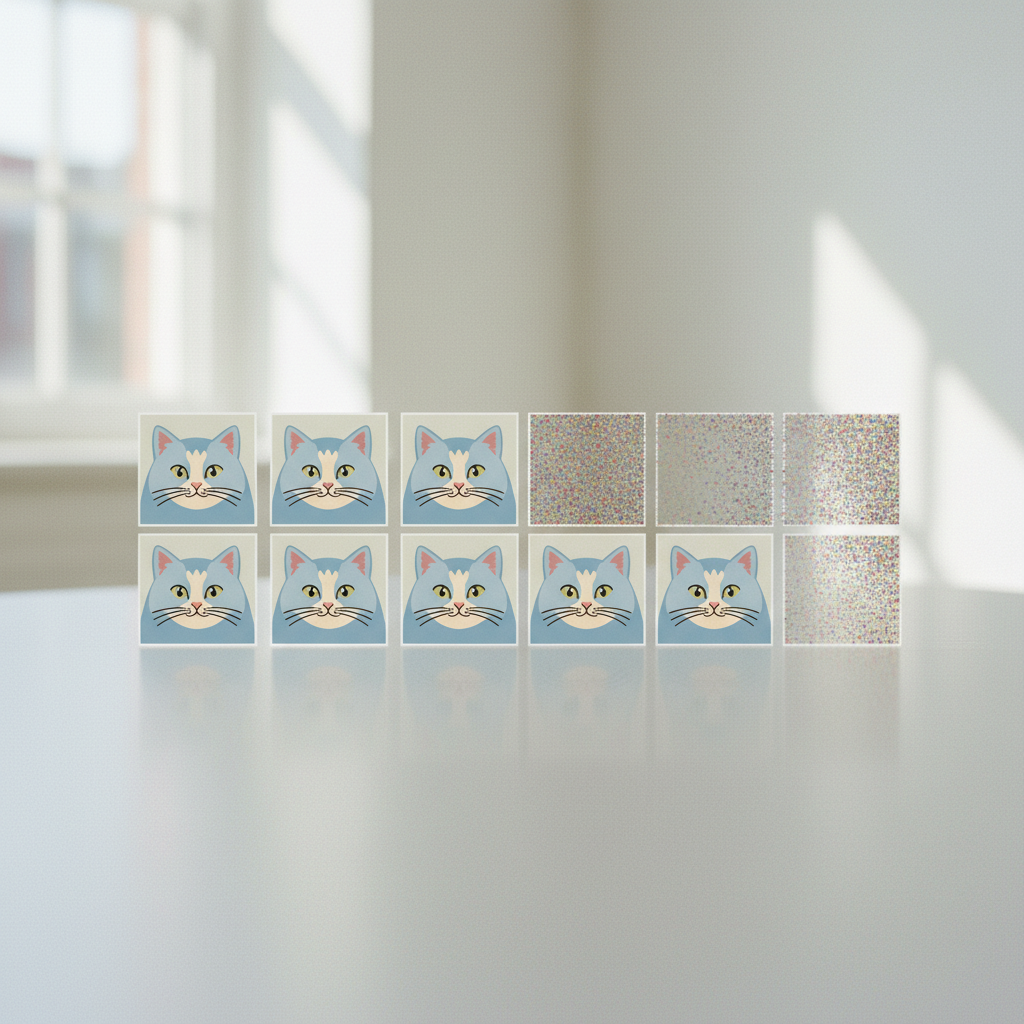
Diffusion models are a type of generative model that work by simulating a diffusion process. Initially, they add noise to data over several steps until the original data is completely obscured. Then, through a reverse process, they gradually denoise the data to create new, synthetic samples. This process is akin to starting with a clear image, slowly adding fog until it’s completely obscured, and then clearing the fog to reveal a new image.
The Core Idea: Adding and Removing Noise
The training of diffusion models involves two main phases: the forward phase, where noise is progressively added to the data until it’s completely random, and the backward phase, where the model learns to reverse this process and reconstruct the original data from the noisy state. This bilateral approach allows diffusion models to learn a detailed representation of the data distribution and generate high-quality samples.
Training and Sampling
Training diffusion models is computationally intensive, involving thousands of forward and backward steps to accurately learn the data distribution. Sampling, or generating new data, follows a similar but reversed process, starting from noise and gradually removing it to synthesize new data. This process can be adjusted for speed or quality, influencing the final output.
Comparison with Other Generative Models
Unlike Generative Adversarial Networks (GANs) and Variational Autoencoders (VAEs), which directly learn the data distribution or an encoded space, diffusion models take a unique approach by explicitly modeling the process of adding and removing noise. GANs involve a competition between two networks, while VAEs encode data into a latent space before reconstruction. Diffusion models, however, operate through a more gradual transformation process.
Notable Architectures and Variants
Notable architectures include Denoising Diffusion Probabilistic Models (DDPM), Denoising Diffusion Implicit Models (DDIM), latent diffusion models, and Stable Diffusion. Each variant has contributed to the flexibility and effectiveness of diffusion models in generating complex and high-quality synthetic data.
Key Applications, Strengths, and Limitations
Diffusion models are celebrated for their ability to generate realistic and diverse outputs, applicable to image and audio synthesis, text-to-image tasks, and more. They offer a high degree of control over the generation process but are also known for their computational intensity and the need for significant training data. Ongoing research focuses on improving efficiency, reducing computational requirements, and exploring novel applications.
Current Research Directions
Research in the field of diffusion models is vibrant, focusing on making these models more efficient, scalable, and capable of handling a wider range of tasks. Efforts to integrate diffusion models with other AI techniques and to develop models that require less data and computational resources are particularly noteworthy.
About the Author